
Session-Based Test Management: Definition and History
Session-based test management turns exploratory testing into a charter, a time-boxed session, and a PROOF debrief, first defined by the Bach brothers in 2000.
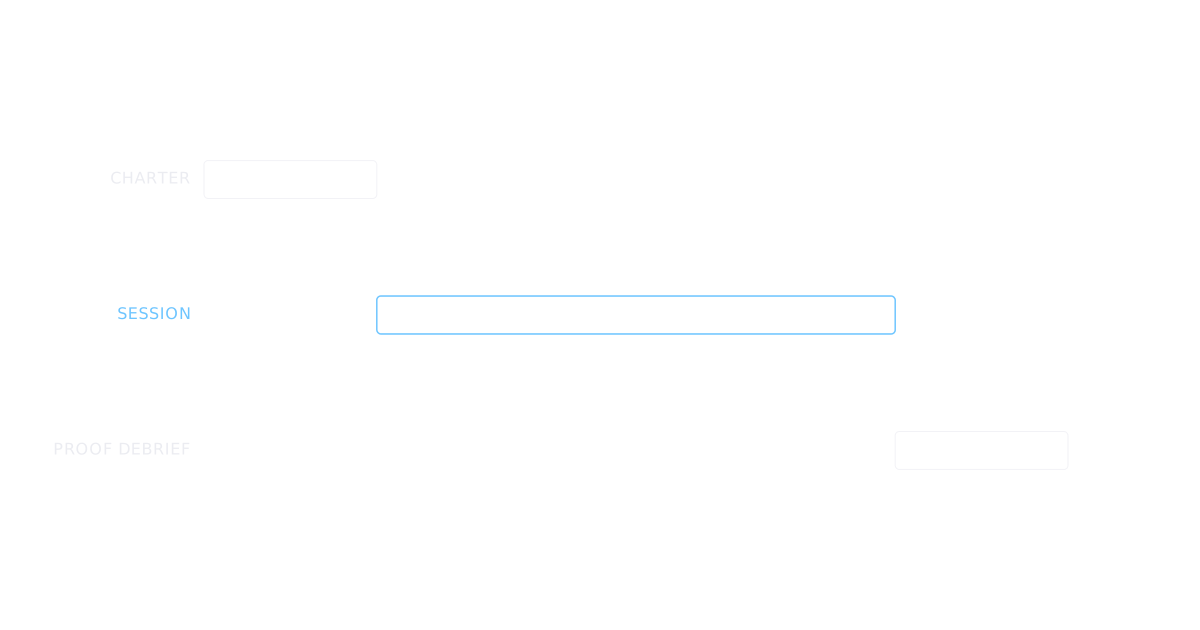
Session-based test management (SBTM) is a structured way to run exploratory testing: unscripted investigation rather than checking against a written test case. SBTM turns that investigation into something a manager can audit by fixing three things in advance: what the tester is scoping for (the charter), how long they get (the session), and what shape the writeup takes (PROOF). That doesn't make exploratory testing less exploratory. It gives the work a name and a shape. SBTM refers to a specific three-part structure, not a synonym for ad hoc testing.
The charter, the time-boxed session, and the PROOF debrief
A charter is a short written mission, drafted before the session starts, that scopes what to explore, with what resources, and to discover what. That written mission is what turns aimless wandering into a bounded investigation: the tester knows, before starting, what would count as done.
A session is the time-boxed block of work a charter runs inside. Wikipedia's session-based testing entry puts it plainly: "An uninterrupted period of time spent testing, ideally lasting one to two hours". The same entry defines the debrief that closes a session as "a short discussion between the manager and tester (or testers) about the session report."
That session report has a fixed shape: PROOF, for Past, Results, Obstacles, Outlook, and Feelings, five fields the debrief works through in order. The field-by-field precision test for a PROOF report lives in Precision in PROOF Debriefs.
The charter template itself, and the time-accounting layer that sits under a session, get their full treatment in the session-based test management walkthrough.
SBTM's origin: the Bach brothers at Hewlett-Packard, 2000
"Session-based testing was developed in 2000 by Jonathan and James Marcus Bach", working together at Hewlett-Packard. The brothers wrote the method up in a paper published November 1, 2000 at satisfice.com.
James Bach describes that paper in his own words: "This is the seminal article on Session-Based Test Management, written by my brother Jon and I based on the process we pioneered at Hewlett-Packard," - James Bach, co-creator of Session-Based Test Management at Satisfice.
The charter, the session, and the debrief all trace back to that single 2000 paper, not to separate additions bolted on later. It remains the primary source for the method, cited on the same Wikipedia page that defines the session and the debrief.
SBTM comes down to three things: a charter that scopes the mission, a one-to-two-hour session, and a PROOF debrief that turns the session into a report. That definition is settled. The harder question is whether a given PROOF report is sharp enough for a manager to act on, and that test lives in Precision in PROOF Debriefs. Read Session-Based Test Management Is the Audit Trail Exploratory Testing Needed next for the full charter walkthrough, the session bookkeeping, and the evidence.